
If you continue browsing this website, you agree to our policies:
  • Cookie statement
  • Privacy policy
  • Rules for guests
Continue
x
Mount Orange
  • Home
  • Calendar
  • More
Site-wide search Close
Toggle search input
English ‎(en)‎
አማርኛ ‎(am)‎ Afaan Oromoo ‎(om)‎ Afrikaans ‎(af)‎ Aragonés ‎(an)‎ Aranés ‎(oc_es)‎ Asturianu ‎(ast)‎ Azərbaycanca ‎(az)‎ Bahasa Indonesia ‎(id)‎ Bahasa Melayu ‎(ms)‎ Bamanankan ‎(bm)‎ Bislama ‎(bi)‎ Bosanski ‎(bs)‎ Brezhoneg ‎(br)‎ Català ‎(ca)‎ Català (Valencià) ‎(ca_valencia)‎ Čeština ‎(cs)‎ Crnogorski ‎(mis)‎ Cymraeg ‎(cy)‎ Dansk ‎(da)‎ Davvisámegiella ‎(se)‎ Deutsch ‎(de)‎ Dolnoserbski ‎(dsb)‎ Ebon ‎(mh)‎ eesti ‎(et)‎ English ‎(en)‎ English (United States) ‎(en_us)‎ Español - Internacional ‎(es)‎ Español - México ‎(es_mx)‎ Español - Venezuela ‎(es_ve)‎ Esperanto ‎(eo)‎ Euskara ‎(eu)‎ Èʋegbe ‎(ee)‎ Filipino ‎(fil)‎ Finlandssvenska ‎(sv_fi)‎ Føroyskt ‎(fo)‎ Français (Canada) ‎(fr_ca)‎ Français ‎(fr)‎ Gaeilge ‎(ga)‎ Gàidhlig ‎(gd)‎ Galego ‎(gl)‎ Gascon ‎(oc_gsc)‎ Hausa ‎(ha)‎ Hrvatski ‎(hr)‎ ʻŌlelo Hawaiʻi ‎(haw)‎ Igbo ‎(ig)‎ isiZulu ‎(zu)‎ Íslenska ‎(is)‎ Italiano ‎(it)‎ Kalaallisut ‎(kl)‎ Kinyarwanda ‎(rw)‎ Kiswahili ‎(sw)‎ Kreyòl Ayisyen ‎(hat)‎ Kurmanji ‎(kmr)‎ Latin ‎(la)‎ Latviešu ‎(lv)‎ Lëtzebuergesch ‎(lb)‎ Lietuvių ‎(lt)‎ Lulesamisk ‎(smj)‎ magyar ‎(hu)‎ Malagasy ‎(mg)‎ Māori - Tainui ‎(mi_tn)‎ Māori - Waikato ‎(mi_wwow)‎ Māori Te Reo ‎(mi)‎ Mongolian ‎(mn_mong)‎ Nederlands ‎(nl)‎ Norsk - nynorsk ‎(nn)‎ Norsk ‎(no_gr)‎ Norsk ‎(no)‎ O'zbekcha ‎(uz)‎ Occitan-Lengadocian ‎(oc_lnc)‎ Pidgin ‎(pcm)‎ Polski ‎(pl)‎ Português - Brasil ‎(pt_br)‎ Português - Portugal ‎(pt)‎ Română ‎(ro)‎ Romansh Sursilvan ‎(rm_surs)‎ Samoan ‎(sm)‎ Setswana ‎(tn)‎ Shqip ‎(sq)‎ Sicilianu ‎(scn)‎ Ślōnski ‎(szl)‎ Slovenčina ‎(sk)‎ Slovenščina ‎(sl)‎ Soomaali ‎(so)‎ Sørsamisk ‎(sma)‎ Srpski ‎(sr_lt)‎ Suomi ‎(fi)‎ Suomi+ ‎(fi_co)‎ Svenska ‎(sv)‎ Tagalog ‎(tl)‎ Tamil ‎(ta)‎ Taqbaylit ‎(kab)‎ Thai ‎(th)‎ Tibetan ‎(xct)‎ Tok Pisin ‎(tpi)‎ Tongan ‎(to)‎ Türkçe ‎(tr)‎ Turkmen ‎(tk)‎ Uyghur - latin ‎(ug_lt)‎ VakaViti ‎(fj)‎ Vietnamese ‎(vi)‎ Wolof ‎(wo)‎ Ελληνικά ‎(el)‎ Башҡорт теле ‎(ba)‎ Беларуская ‎(be)‎ Български ‎(bg)‎ Кыргызча ‎(ky)‎ Қазақша ‎(kk)‎ Македонски ‎(mk)‎ Монгол ‎(mn)‎ Русский ‎(ru)‎ Српски ‎(sr_cr)‎ Татар ‎(tt)‎ Тоҷикӣ ‎(tg)‎ Українська ‎(uk)‎ ქართული ‎(ka)‎ Հայերեն ‎(hy)‎ עברית ‎(he)‎ ئۇيغۇرچە ‎(ug_ug)‎ اردو ‎(ur)‎ العربية ‎(ar)‎ دری ‎(prs)‎ سۆرانی ‎(ckb)‎ فارسی ‎(fa)‎ لیسي ‎(ps)‎ ދިވެހި ‎(dv)‎ ⵜⴰⵎⴰⵣⵉⵖⵜ ‎(zgh)‎ ትግርኛ ‎(ti)‎ नेपाली ‎(ne)‎ मराठी ‎(mr)‎ हिंदी ‎(hi)‎ বাংলা ‎(bn)‎ ਪੰਜਾਬੀ ‎(pan)‎ ગુજરાતી ‎(gu)‎ ଓଡ଼ିଆ ‎(or)‎ தமிழ் ‎(ta_lk)‎ తెలుగు ‎(te)‎ ಕನ್ನಡ ‎(kn)‎ മലയാളം ‎(ml)‎ සිංහල ‎(si)‎ ລາວ ‎(lo)‎ རྫོང་ཁ ‎(dz)‎ ဗမာစာ ‎(my)‎ ខ្មែរ ‎(km)‎ 한국어 ‎(ko)‎ 日本語 ‎(ja)‎ 正體中文 ‎(zh_tw)‎ 简体中文 ‎(zh_cn)‎
You are currently using guest access
Log in
Mount Orange
Home Calendar
Expand all Collapse all

Blocks

Skip Funding Credits

Funding Credits

Part funded by

Eramus+

In partnership with


Flexible Education Norway

The Alzheimer Society of Ireland

IC DIEN

  1. Dementia Care
  2. Week 6: Course Review and Next Steps
  3. My Course Reflection

My Course Reflection

Completion requirements

As we approach the end of Home Based Care - Home Based Education, we would like to invite you to reflect on your participation on this course. Some people find it useful to record their experience by writing them down on paper. The Reflective Model below might help you to break this task down into manageable component parts.
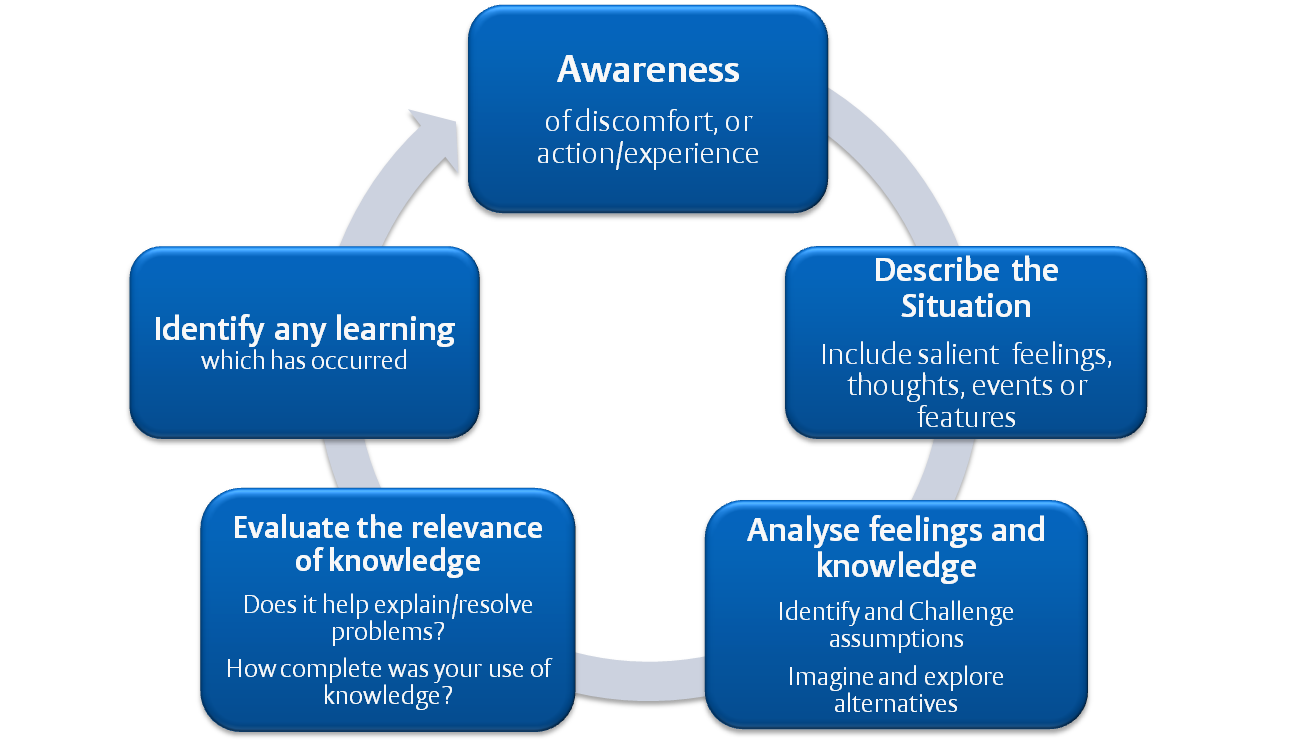
Atkins model for course reflection

Source: Atkins, S. and Murphy, K. (1994) Reflective Practice. Nursing Standard 8(39) 49-56.

You could use the above model in the following way:

Awareness: You were aware of your need to do the course. You might like to describe your feelings pre-course and why you sought out training.

Describe the Situation: Here you can describe the course, paying special attention to how you felt while doing the course, for example, how did it feel to participate in Forums where you were sharing sensitive information. Were there any particular 'stand out' moments on the course for you? If so, describe them and what they meant to you.

Analyse Feelings and Knowledge: Here you can try to analyse what you have learned and what it has felt like to come across new meanings / choices / interpretations. Have these caused you to think about doing things differently?  

Evaluate the relevance of knowledge: Does any new knowledge / perspectives gleaned from your participation on the course help in resolving / improving your care situation? If so describe giving some examples.

Identify any learning: Having completed the course are there still gaps in your knowledge? What more do you need to do to improve in practical ways your care situation?


Use the model provided above, or if you prefer, just write down your thoughts and feelings on what participating on this course has meant for you. Has the course changed you as a carer, and if so, how?


You are currently using guest access (Log in)
Data retention summary
Policies
Get the mobile app
Powered by Moodle